

 Facebook
 X
 Pinterest
 Copy Link
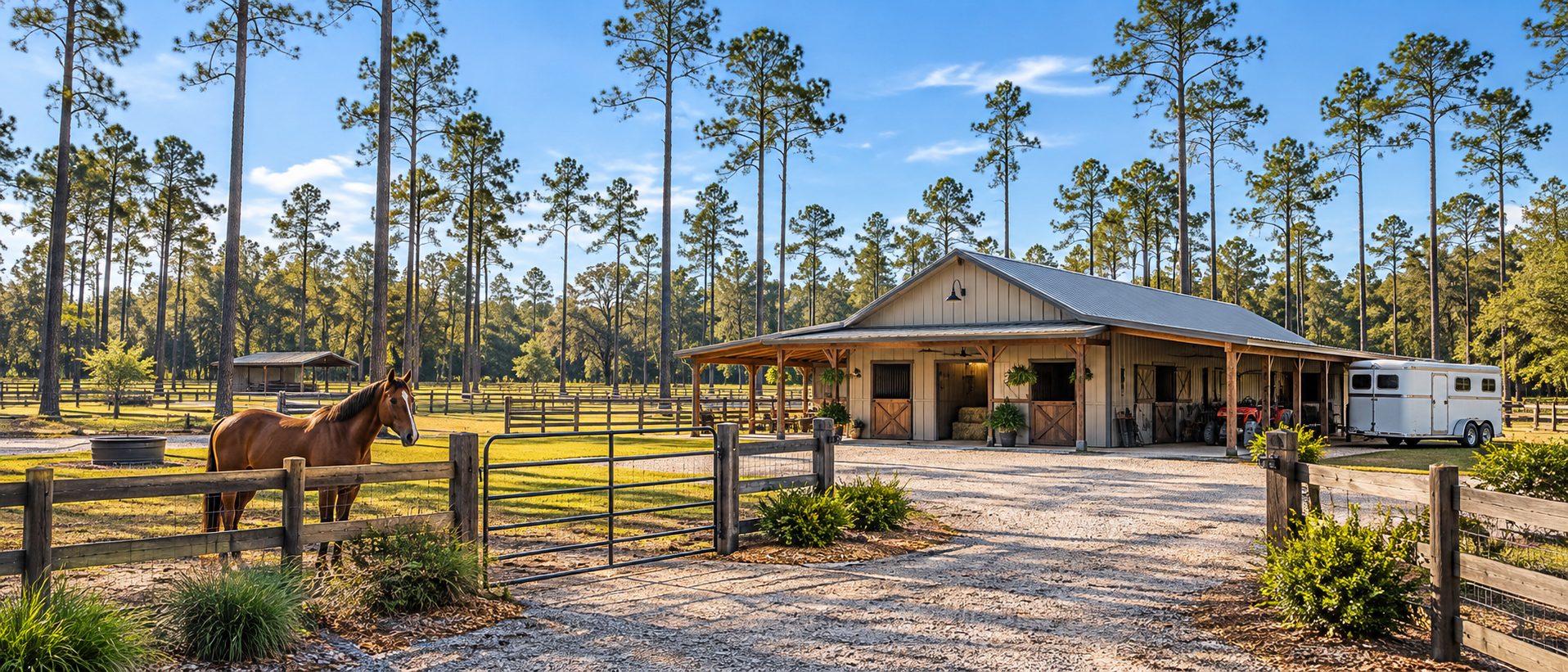
Why the details beyond the barn can make a difference when marketing equestrian acreage.
There’s something about a good horse property that catches your attention.
A beautiful pasture. A well-kept barn. Horses grazing under the trees.
Those things can make a wonderful first impression.
But after years of working with land, farms, and country properties around Northwest Florida, I’ve learned that the people seriously considering a horse property usually want to know quite a bit more.
They want to know how everything works together.
And if you’re getting ready to sell, helping buyers understand that is one of the smartest things you can do.
A Horse Property Is More Than a House and a Barn
When someone looks at a traditional home, they’re usually thinking about the floor plan, condition, neighborhood, and price.
Horse-property buyers have another whole set of questions.
How do you get from the barn to the pasture?
Are there separate paddocks?
Where’s the water?
Can you get a truck and trailer in and out comfortably?
Is there room for equipment, feed, and hay?
These aren’t little details to someone who plans to keep horses on the property.
They’re part of everyday life.
That’s why I encourage sellers to think about what horse-property buyers are looking for beyond the fence before we begin marketing.
Show How the Property Is Laid Out
One of the biggest challenges in marketing acreage is helping buyers understand the relationship between everything on the property.
A beautiful photograph of the house is important.
So is a good picture of the barn.
But buyers also need to see how those buildings relate to each other.
Where are the pastures?
How are the paddocks divided?
Where does the driveway lead?
How much of the acreage is open, and how much is wooded?
Aerial photography can be especially helpful here. So can photographs showing the gates, fencing, barn entrances, and other working areas.
The goal isn’t just to show buyers what the property looks like.
It’s to help them picture how they would use it.
Make Fences, Gates, and Access Easy to Evaluate
If you’ve owned a horse property for years, you probably don’t think much about opening the gates or driving around the barn.
You know how everything works.
A buyer doesn’t.
Before showings, take a good look at the practical areas of the property.
Are the gates operating properly?
Are there fence boards or sections that need attention?
Can buyers see where pasture divisions begin and end?
Are access routes clear?
Is there a place to turn a truck and trailer around?
You don’t have to make an older property look brand new.
But you do want buyers to see that the important working parts have been maintained.
And if something needs repair, it’s better to understand that before it becomes a question during negotiations.
Water and Drainage Deserve Attention
Anyone familiar with Northwest Florida knows we can get plenty of rain.
That makes drainage an important consideration for rural property, particularly where animals are kept.
Buyers may want to understand where water collects, how pastures drain, and whether there are areas that become difficult to use during wet weather.
Water availability is another important part of the picture.
Are there water connections or troughs in the pastures?
Does the barn have water?
Is the property served by a private well or another source?
If you’ve maintained a well, drainage improvements, or other systems, having documentation available can help answer questions.
A seller doesn’t need to promise that every part of the property stays dry after a heavy rain.
But accurate information about how the land behaves is valuable.
Let the Barn Tell Its Own Story
A barn doesn’t have to be fancy to be useful.
I’ve seen simple, practical buildings that work very well for the people who own them.
What matters is how they’re built, maintained, and arranged.
Before listing, consider what buyers will want to know about:
- Stalls and their dimensions
- Feed and tack storage
- Ventilation and drainage
- Electrical and water service
- Roof and structural condition
- Equipment storage
- Access between the barn and pastures
If you’ve made improvements over the years, gather whatever records, permits, or other documentation you have.
Those details help buyers understand what’s there and what may still need attention.
Don’t Assume Every Improvement Adds Its Full Cost to the Price
This is an important one.
A seller may have invested a great deal in fencing, a barn, riding areas, or other improvements.
And those improvements may be very valuable to someone who needs them.
But that doesn’t necessarily mean a buyer will pay back every dollar spent.
Property value depends on more than the cost of improvements.
Location, acreage, condition, usability, and the number of buyers interested in that type of property all matter.
The same is true when selling a home with acreage and explaining what the entire property offers.
Good pricing means looking at the whole property and understanding how its features compare with other properties buyers may consider.
Remember That Not Every Acreage Buyer Has Horses
A property with a barn and fenced pasture may attract horse owners.
But it may also appeal to someone who wants a hobby farm, room for other animals, a workshop, or simply more space.
That doesn’t mean we should market every horse property as suitable for every possible use.
Zoning, restrictions, improvements, and the property’s actual capabilities still matter.
It does mean we should present the property clearly enough for different buyers to understand its possibilities.
Sometimes a buyer will appreciate the barn exactly as it is.
Another may see a different future for the land.
Knowing why the surrounding land and property features matter as much as the house helps put those possibilities in perspective.
My Honest Advice
If you’re preparing to sell a horse property, walk it as though you’re seeing it for the first time.
Start at the entrance.
Follow the driveway.
Look at the gates.
Walk the fence lines.
Step inside the barn.
Look at the pastures and the water sources.
Think about what a buyer would need to know to feel comfortable taking care of the property.
Then gather the information that helps answer those questions.
A clean barn and a beautiful pasture make a good impression.
But understanding how everything works is what helps buyers make a confident decision.
Final Thought
A good horse property is more than a pretty place to keep animals.
It’s a combination of land, buildings, access, and practical details that make everyday life work.
When it’s time to sell, those details deserve just as much attention as the house itself.
Because the right buyer isn’t just looking for a beautiful property.
They’re looking for one that works for the life they want to live.
Janet Johnson
Where experience meets home.
